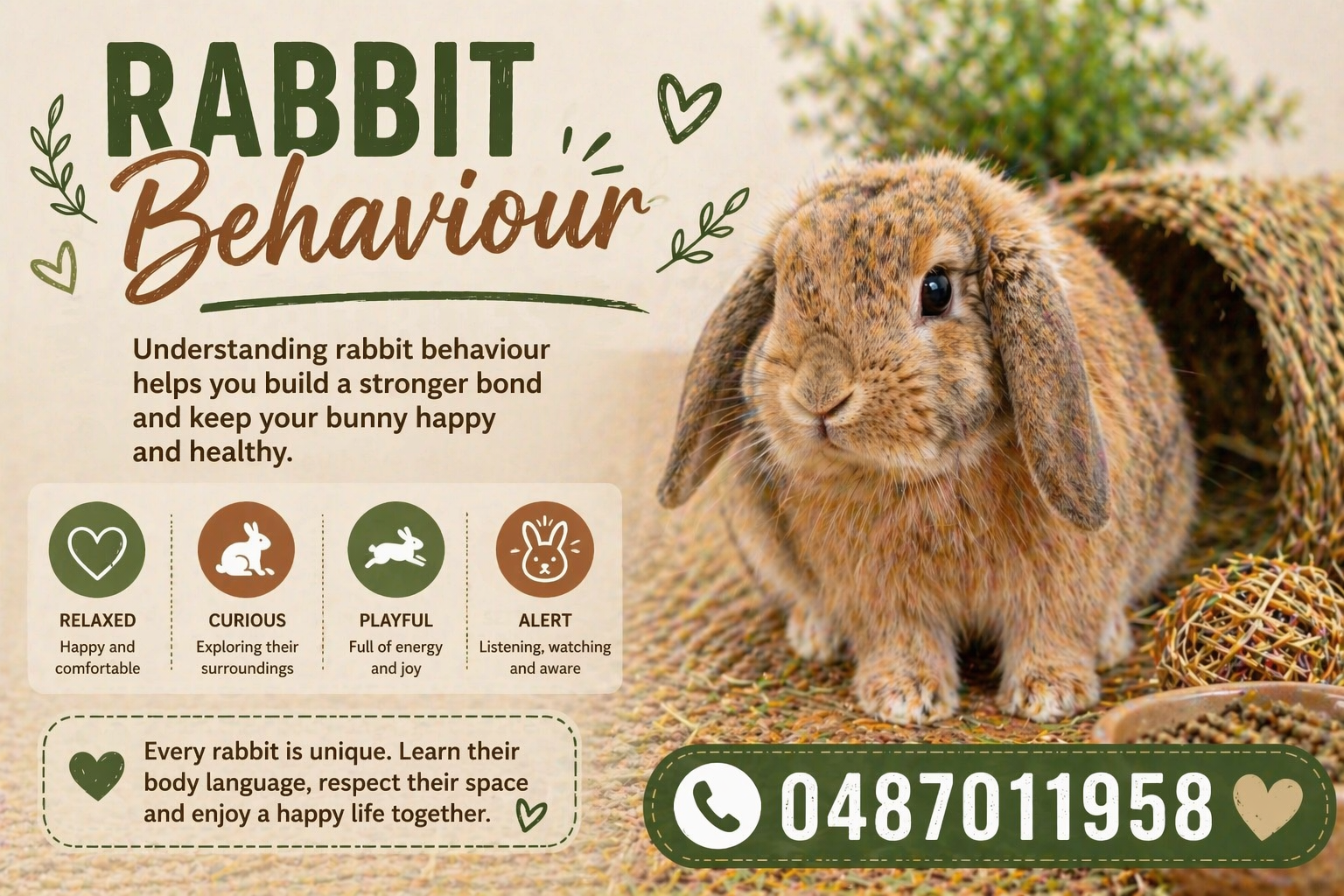
If you have adopted one of our baby rabbits, please read the following guidelines to ensure you’re prepared to provide the best care for your new pet:
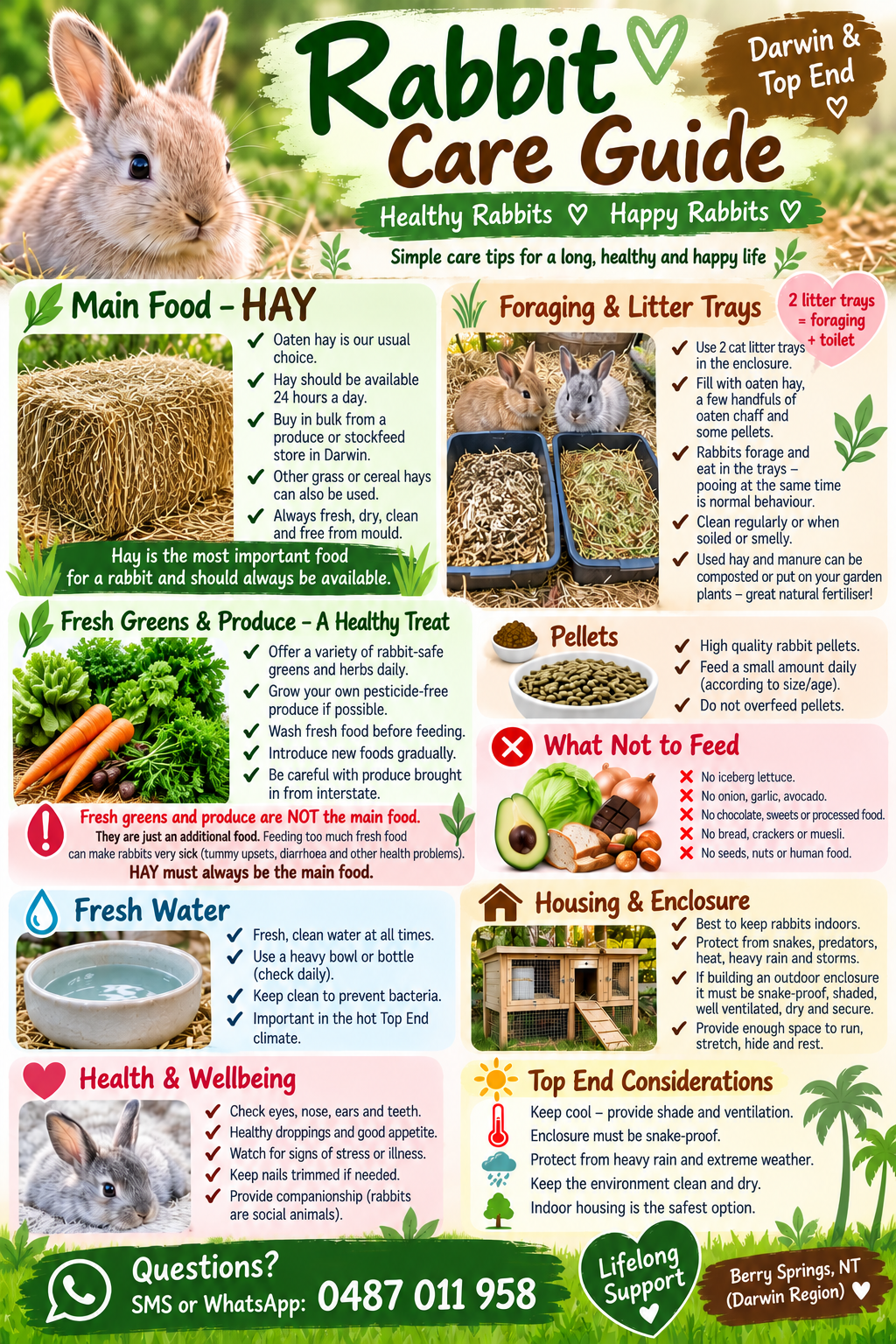
🐰 Rabbit Care Guide – Darwin & the Top End
Rabbits can make wonderful companions, but they need the right food, housing and daily care to stay healthy and happy.
Living in Darwin and the Top End also brings some special considerations. Heat, heavy rain, snakes and our tropical environment all need to be considered when setting up a safe home for your rabbit.
This guide covers the basics we recommend for our rabbits and their new families.
🌾 Hay – The Most Important Food
Good-quality hay should make up the main part of an adult rabbit’s diet and should be available 24 hours a day.
We normally use oaten hay, which can be purchased economically in bales from local produce and stockfeed stores.
Depending on availability, other suitable grass or cereal hays can also be used.
Choose hay that is:
✓ Fresh and dry
✓ Clean and good quality
✓ Free from mould
✓ Not excessively dusty
Buying hay in bulk from a produce store is usually much more economical than buying small bags from pet shops.
🐰 Our Foraging & Litter-Tray Method
One simple setup works particularly well for our rabbits.
Place two cat litter trays inside the rabbit enclosure and fill them with:
🌾 Plenty of oaten hay
🌾 A few handfuls of oaten chaff
🥣 A small amount of rabbit pellets
The rabbits can dig and forage through the hay and chaff to find the pellets.
Don’t be surprised when your rabbit eats and poos in the same area. This is normal rabbit behaviour and makes the litter trays a natural place for them to toilet while they eat and forage.
Clean the trays regularly and replace the hay and chaff when they become soiled or smelly.
🌱 Don’t Waste the Rabbit Manure
Rabbit manure and used hay can be useful in the garden.
Rather than simply throwing it away, it can be composted or used around suitable garden plants as organic garden material.
It’s an easy way to turn the daily enclosure clean-up into something useful.
🥬 Fresh Greens
Fresh greens and vegetables can be offered as additional food, but they should never replace hay as the main part of your rabbit’s diet.
🌾 Hay is the main food and should always be available.
Feeding too much fresh produce, particularly when a rabbit is not accustomed to it, can upset the digestive system and may make your rabbit very sick.
Where possible, we prefer home-grown, pesticide-free greens and herbs. Growing some of your rabbit’s food yourself means you know where it came from and what has — or hasn’t — been sprayed on it.
✓ Feed fresh greens as an addition to hay
✓ Introduce new foods gradually
✓ Choose pesticide-free produce
✓ Wash fresh produce before feeding
✓ Never feed plants sprayed with pesticides, herbicides or other chemicals
✓ Make sure plants are safe for rabbits
✓ Be careful with plant material brought in from interstate
🌿 Home-grown, pesticide-free and fresh is best.
🥕 Fruit and sweeter vegetables such as carrot should only be given in small amounts as occasional treats.
Remember: fresh produce is an extra — hay remains the main food.
💧 Fresh Water Every Day
Rabbits need constant access to fresh, clean drinking water.
In our tropical climate, water needs particular attention. Check it regularly and make sure bowls or containers haven’t become dirty, tipped over or heated excessively.
Heavy ceramic bowls can work well because they are harder for rabbits to tip over.
🏡 Indoors Is the Safest Option
For the Top End, we recommend keeping pet rabbits indoors whenever possible.
An indoor environment makes it much easier to protect rabbits from:
🐍 Snakes
☀️ Extreme heat
🌧️ Heavy tropical rain
⛈️ Storms and severe weather
🐕 Dogs and other predators
🦟 Insects and other environmental hazards
Rabbits still need plenty of room to move around, explore, stretch out and exercise. They shouldn’t spend their lives confined to a small cage.
🌴 If You Keep Rabbits Outdoors
If you decide to build an outdoor enclosure, it needs to be designed specifically for Top End conditions.
Most importantly, it must be snake-proof.
That means thinking about the entire enclosure — not just the walls.
The roof, sides, floor, doors and even small gaps need to be secure. Ordinary chicken wire alone should not be relied upon to make an enclosure snake-proof.
Your rabbits also need:
✓ Permanent shade
✓ Protection from direct sun
✓ Good ventilation
✓ A completely dry sheltered area
✓ Protection from heavy rain and storms
✓ Secure protection from dogs and other predators
✓ Enough room to run, stretch, hide and rest
Always remember that the conditions can change quickly in the Top End. An enclosure that feels comfortable early in the morning may become dangerously hot later in the day.
☀️ Heat Is a Serious Consideration
Rabbits cope much better with cooler conditions than extreme heat.
During Darwin’s hotter months, pay particular attention to where your rabbit is housed and make sure it has a cool, shaded environment and constant access to fresh water.
Never leave a rabbit in an enclosure exposed to direct tropical sun.
🧹 Keep Their Environment Clean
Check your rabbit’s living area every day.
Remove wet or heavily soiled bedding, clean litter trays regularly and make sure food and water containers remain clean.
At the same time, don’t be alarmed by every rabbit dropping you see. Rabbits naturally produce a lot of droppings.
Daily cleaning also gives you an opportunity to notice changes in your rabbit.
❤️ Know Your Rabbit
One of the most important parts of rabbit care is simply knowing what is normal for your rabbit.
Pay attention to how much they normally eat and drink, how active they are and what their droppings normally look like.
A rabbit that suddenly stops eating, produces significantly fewer droppings, becomes unusually quiet or shows other signs of illness should not simply be left to see whether it improves.
If you’re concerned about your rabbit’s health, contact a veterinarian experienced with rabbits.
💚 Our Support Doesn’t End at Adoption
When one of our rabbits goes to a new home, our support doesn’t end there.
We want our rabbits to have happy, permanent homes, and we’re always happy to help their new families with practical questions about feeding, housing, settling in and everyday care.
If you’re unsure about something, please ask.
🐰 Rabbit Care & Adoption – Darwin / Berry Springs NT
📱 SMS or WhatsApp: 0487 011 958
💚 Rabbit Care Guide + lifelong support
Rabbits do not tolerate extreme heat well. Darwin and the Top End can become dangerously hot and humid for rabbits.
Rabbits must always have access to deep shade, good airflow and plenty of fresh, cool water. Never leave a rabbit in direct sun, a hot shed, enclosed hutch, vehicle or other area where heat can build up.
On very hot or humid days, outdoor shade alone may not be enough. Your rabbit needs access to a genuinely cool, well-ventilated area. Frozen water bottles wrapped in a towel can also provide a cool surface to rest against.
Watch carefully for signs of heat stress, including panting or rapid/shallow breathing, drooling, weakness, lethargy, unusually hot/red ears or collapse. Heatstroke is an emergency — contact a veterinarian immediately. Do not suddenly immerse or pour cold water over an overheated rabbit; cooling needs to be gradual while veterinary help is sought. If you cannot provide a reliably cool environment during Top End heat, a rabbit may not be a suitable pet for your setup.
Rabbits are social animals and generally benefit from living with a compatible, properly bonded rabbit. They do best when living with at least one compatible rabbit. Bonded pairs of rabbits provide each other with comfort and companionship, but the bonding process requires time and patience. Desexing is strongly recommended when rabbits are kept together to prevent unwanted litters and can assist with bonding.
🌾 Hay – Available at All Times
Rabbits must always have access to fresh, dry hay. Hay is the most important part of their diet and helps keep their digestive system and teeth healthy.
For rabbits in the Darwin/Top End area, suitable options include:
- Oaten hay – a good everyday choice
- Rhodes grass hay – suitable if clean, dry and good quality
- Pasture or grass hay – also suitable
- Lucerne hay – better for young, growing, pregnant or nursing rabbits; it should not normally be the main unlimited hay for adult rabbits
Hay should smell fresh and be free from mould, excessive dust and moisture. Never feed damp or mouldy hay.
🌿 Fresh Grass
Rabbits can also eat fresh grass. Introduce new grasses gradually, especially when taking a rabbit to a new home.
Only collect grass from areas that are free from pesticides, herbicides and other chemicals. Do not feed lawn-mower clippings, as they can heat and ferment quickly.
🥣 Pellets
A good-quality rabbit pellet can be provided in addition to hay and grass. Pellets should not replace hay.
Avoid suddenly changing the rabbit’s pellets when you first take your rabbit home. If you want to change brands, gradually mix the new food with the old food.
💧 Water
Clean, fresh drinking water must be available 24 hours a day.
In Darwin’s hot climate, check water frequently and keep containers out of direct sun where possible.
🥕 Vegetables & Treats
Fresh leafy vegetables can be introduced gradually. Carrot and fruit should only be given in small amounts as treats.
⚠️ When You First Take Your Rabbit Home
For the first few days, keep the rabbit’s diet as similar as possible to what it was eating before. Sudden changes in food can upset a rabbit’s digestive system.
A healthy rabbit should be eating regularly and producing plenty of normal droppings. If your rabbit stops eating, stops producing droppings, develops diarrhoea, or becomes unusually quiet, seek veterinary advice promptly.
Rabbits are small, delicate animals and can be seriously injured very easily. Even a friendly, confident rabbit needs a safe and secure environment.
⚠️ Common Household & Property Dangers
Swimming pools, ponds & water containers
Rabbits can fall into swimming pools, ponds, buckets, troughs or other water containers and drown. Never allow a rabbit unsupervised access to these areas. Pools and ponds should be securely fenced or inaccessible.
Being stepped on
Rabbits are often very quiet and may suddenly run behind or underneath your feet. Always look where you are walking, particularly at night or when the rabbit is loose inside the house. Teach visitors and children to do the same.
Doors & gates
Always check before closing doors, gates or enclosure panels. A rabbit may be sitting behind them or attempting to follow you through.
Recliners, sofas & furniture
Rabbits may hide underneath furniture. Reclining chairs and sofa mechanisms can cause severe injuries. Always locate your rabbit before moving furniture or operating a recliner.
Cars & machinery
Never allow rabbits to roam around driveways, garages, vehicles, mowers or other machinery. Check underneath vehicles before moving them.
🐕 Dogs, Cats & Other Animals
Even a normally friendly dog or cat can seriously injure or kill a rabbit within seconds.
Never assume that animals are safe together simply because they have previously behaved well. Introductions should be carefully controlled and rabbits should have a secure area where other animals cannot reach them.
🦅 Outdoor Predators
In the Darwin/Top End area, rabbits need protection from dogs, cats, snakes and birds of prey.
Outdoor enclosures should be secure from the sides, underneath and above. Check regularly for holes, damaged wire or places where predators could enter.
☀️ Heat
Rabbits can become dangerously overheated.
In the Top End climate, rabbits must have shade, ventilation and access to a cooler protected area at all times. Never leave a rabbit in direct sun, a closed vehicle, hot shed or poorly ventilated enclosure.
🧒 Children
Young children should always be supervised around rabbits.
Rabbits generally prefer being handled close to the ground. They can struggle suddenly when frightened and may be badly injured if dropped.
Children should be taught not to chase, squeeze, carry or pick up a rabbit without supervision.
🔌 Electrical Cables & Poisonous Substances
Rabbits naturally chew. Keep electrical cables, chargers and extension leads completely out of reach.
Also prevent access to:
- Cleaning products and chemicals
- Pesticides and poisons
- Rat or mouse bait
- Fertilisers
- Medications
- Cigarettes and vaping products
- Plastic, foam and other materials that may be swallowed
- Plants that have not been confirmed as rabbit-safe
🏠 Escaping
Rabbits can squeeze through surprisingly small spaces and can also dig underneath fences.
Check the enclosure regularly and make sure gates are properly closed. A rabbit that escapes may quickly encounter roads, dogs, snakes, neighbouring properties or other dangers.
🚨 Know Your Rabbit
Spend a little time observing your rabbit every day. You will quickly learn what is normal for them.
Seek veterinary advice promptly if your rabbit suddenly:
- Becomes unusually quiet or weak
- Has difficulty breathing
- Cannot stand or walk normally
- Has been dropped or stepped on
- Has been attacked or bitten by another animal
- Has fallen into water or nearly drowned
- Is bleeding or has an obvious injury
- Appears to be in pain
- Is behaving very differently from normal
Rabbits often hide illness and pain. If something does not look right, don’t wait for the rabbit to become obviously sick before seeking advice.
Keeping rabbits indoors is becoming increasingly popular. This arrangement allows you to form a closer bond with your rabbits while keeping them safe from outdoor dangers. Provide a rabbit-proof, escape-free area, and consider toilet training them for added convenience.
Indoor rabbits still benefit from outdoor access to a secure, predator-proof space. You might even train them to use a cat flap for supervised outdoor play. Be sure to keep hazardous items, like electrical cords and cleaning products, safely out of reach.
A common myth is that rabbits can live solely in a hutch. In reality, a hutch should only be a safe resting place. Rabbits need plenty of room to run, jump, and express natural behaviors. Ideally, their hutch should be attached to a large run or enclosure with ample space.
At a minimum, a suitable enclosure for two rabbits should measure 3m long x 1.5m wide x 1m high, as recommended by the Rabbit Welfare Association and Fund. Inside the enclosure, include a burrow-like space with clean bedding and a separate area for toileting. Burrowing is a natural behavior that helps them feel secure.
The hutch must also be predator-proof, weather-resistant, and equipped with fly-proof netting to protect against mosquitoes.
Rabbits are active and intelligent creatures that need daily exercise and mental stimulation. They enjoy running, jumping, digging, and exploring. Make their environment engaging by providing toys, tunnels, and safe digging areas.
If possible, give your rabbits supervised access to a grassy, enclosed area for exercise. Alternatively, let them roam safely inside your home. Daily grooming and playtime are essential for bonding and keeping them happy.
Please arrange a rabbit-experienced veterinarian before you need one. If your rabbit stops eating or producing normal droppings, becomes very quiet, has trouble breathing or appears unwell, seek veterinary advice promptly.